How Moderation Works on Sequel:
Spotting Fake Profiles, Reports & Bans
Worried about fake profiles on dating sites? Learn how to spot a fake dating profile, how our reports-and-bans system works, and why Sequel is built to be one of the few dating platforms with zero tolerance for fake profiles.
If you've spent any time on a dating app, you've probably come across at least one profile that seemed strange and questionable. It may be a too flawless image or a bio that reads like it had been assembled from spare parts. Another common warning signal is a message that landed in your inbox thirty seconds after you created your account. You're not imagining things, and you're not being paranoid. Fake profiles on dating sites are a well-documented problem, and they disproportionately target people over 50.
While creating Sequel, we took this reality into account and did our best to build a secure and comfortable environment for mature dating. This article walks you through exactly how our moderation system works. You'll learn what happens upon sign-up, how to tell if a dating profile is fake, and what you can do on your end to protect yourself.
How online dating works – and why fake profiles exist
Most dating platforms operate on a straightforward loop: more users = more engagement > more engagement = more revenue. That creates structural pressure to grow fast, sometimes at the expense of quality control. When the doors open wide, not everyone who walks through them has good intentions.
The most common types of wrongdoers are:
- Romance scammers build convincing personas over weeks or months, establishing emotional trust before introducing a manufactured crisis. Typical scenarios are a medical emergency or a business deal gone wrong. The statistic is shocking. Americans over 60 lost $3.4 billion to fraud in 2023, with romance scams among the most common vectors.
- Bot farms are automated accounts created at scale to inflate user numbers or redirect people toward third-party platforms. They often mimic human behavior well enough to pass a first glance.
- Data harvesters aren't there to connect at all. They're collecting personal information for resale or targeted phishing.
The 50+ demographic is specifically in the crosshairs because, statistically, this group has more accumulated wealth, may be re-entering the dating world after a long relationship, and is sometimes less familiar with the tactics fraudsters use. That doesn't mean there is something wrong with modern elders. It's simply the landscape. And knowing the terrain is half the battle.
How Sequel handles reports, verification, and bans
Many dating platforms moderate reactively. They wait for something to go wrong before stepping in. Sequel sticks to a different method. Our approach is proactive by design. The goal is to stop bad actors before they reach you, not after the damage is done.
We have created a layered system of verification, human review, and community reporting. This powerful combination works quietly in the background, without distracting you from matches.
Verification before visibility
Before a new profile ever becomes visible to the Sequel community, it passes through a dual-layer verification process.
AI scanning
Every new account is automatically analyzed for synthetic content. Cutting-edge algorithms analyze content for AI-generated photos, inconsistent metadata, and implausible registration patterns. This happens in real time and catches the majority of fabricated accounts before they ever go live.Human review
If the AI flags anything unusual or when a profile simply warrants a closer look, a human moderation specialist steps in. Real eyes mean more meticulous judgment. No algorithm can fully replicate such contextual evaluation.
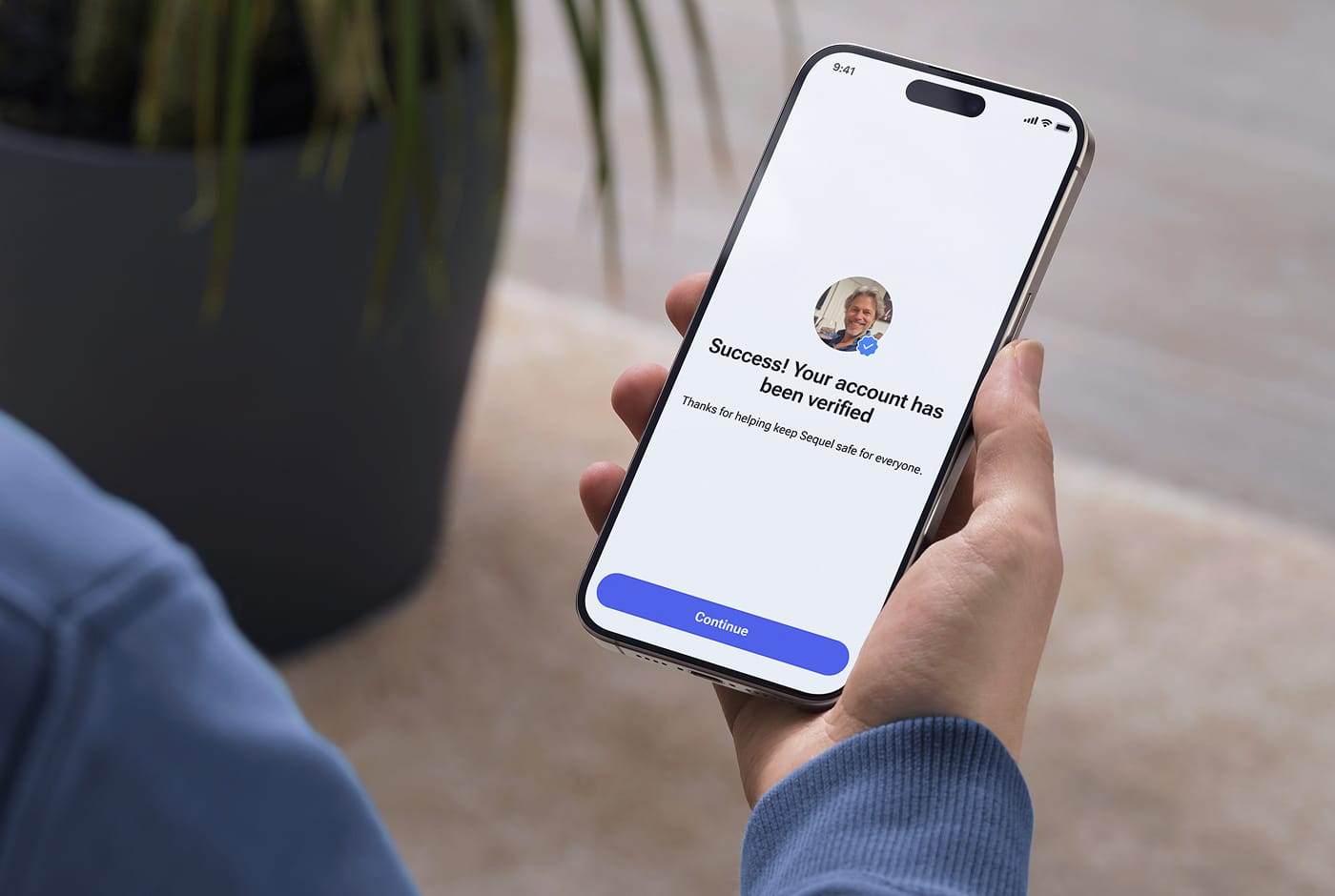
Profiles that pass both layers earn a Verified badge. This is a visible signal to other members that this person has been reviewed and confirmed as real. When you're reaching out to someone for the first time, it is comforting to see such a badge.
Sequel has a zero-tolerance policy toward:
- Fake profile photos or avatars
- Heavily filtered images meant to deceive
- Inconsistent or fabricated personal information
- Any content that suggests a synthetic identity
The team behind Sequel not only wants to catch fakes but strives to build a safe dating environment for the Second Act Generation.
What happens when you report someone
No moderation system, even a sophisticated and modern one, sees everything. That's why you should understand how to tell if a dating profile is fake and use the community reporting tool.
If something disturbs you on Sequel, trust that instinct and inform moderators.
- You file a report. From any profile or conversation, you can flag suspicious behavior in a few taps. You don't need proof. A clear signal is enough.
- The report is reviewed immediately. Sequel's system treats incoming reports as high priority. They trigger fast scanning by a moderation team.
- A specialist investigates. Every report is reviewed by a human, cross-referenced against the user's account history, behavior patterns, and any prior flags.
- Action is taken. If a violation is confirmed, consequences are applied. It can be a warning or a permanent ban, depending on severity.
You'll receive a notification confirming your report was received and reviewed. And if you're ever on the fence about whether something is worth flagging, report it anyway. It costs you nothing, but may protect someone else a great deal.
Bans and why they stick
When a user is banned, their account is immediately deactivated. Their profile, chat history, and all associated activity become invisible to other users. To help prevent banned users from simply creating a new account, we retain certain profile data. Thus, our team can recognize and flag similar patterns if a re-registration attempt is made.
Behaviors that trigger a ban:
- Sending suspicious or manipulative messages
- Requesting money or financial information from other users
- Submitting fraudulent verification documents
- Repeated violations of community standards
- Any form of harassment or abuse
How to spot a fake dating profile and build connections safely on Sequel
Even within a curated, well-moderated environment, good habits go a long way. We recommend treating personal safety less as a set of restrictions and more as a skill, which can make the whole dating experience easier and more enjoyable.
A few practices worth making second nature:
- Keep your bio free of personal contact details. Sequel's system restricts this automatically, but it's worth understanding why. Identifiers in public profiles are a common entry point for bad actors.
- Hold off on sharing your address or workplace until you've met in person and built some real trust over time.
- Keep financial information completely off the table. If a match asks you about financial details repeatedly or requests money, treat it as a red flag and report it immediately.
- Suggest a video call early. It's the simplest way to confirm that the person you're talking to is who they say they are. Most genuine people are happy to do it. Most fake profiles can't.
- Use the report button generously. You're not overreacting. You're helping protect the community, including the next person that account may have targeted.
One more thing worth keeping in mind. Sequel's intent-first design naturally filters out a lot of the behavior that fuels fake profiles in the first place. A person who creates a fraudulent account to exploit someone is rarely interested in a platform built around a genuine, long-term connection.